Epiphany

“May I share the bench with you?”

It was a young woman pushing a stroller with a sleeping baby. “Of course,” I answered, smiling, and waved my hand at the empty space.  She nodded at me, her wide-brimmed hat and sunglasses blocking much of her face.  She sat down carefully, brushing leaves off the bench first and took out her phone. The international “I’d rather not talk” signal. Which was fine; I wasn’t lonely. We were in Flood Park, near my home, in a back corner surrounded by redwood trees. I often lean my bike against one of the trees and sit on my favorite bench, listening to music or reading a book. It’s usually enough for me to feel the shade of a few redwoods to find peace, even if it’s just half an hour.

Peace had been elusive that morning, though. I was having one of what my husband calls my  “sad days”. One of those days when your chest feels inexplicably heavy, like it’s weighing down relentlessly on your stomach.

I do not understand this melancholy.

I am grateful. Recently retired, in my own home, two successful grown children, a long marriage, good friends. And there it is… the missing piece is that nothing is missing.

No struggles, no workday challenges in the classroom, no sacred moments of success to round out the harrowing moments of failure, no goals, no purpose, no value.

I watched sun rays filter down through the tree branches, until one ray of light fell on the hand of the sleeping baby. Gently curved, with delicate tiny pink fingernails. And the wrist – oh the beauty of it! – not a wrist at all, but a crease in the skin between two chubby layers of fat.

The heartbreaking perfection of it brought back the infancy of my own children. How I’d loved them over the moon, and pulled them close to sniff their smell, and been moved to tears by watching them sleep.

And it was enough.

The purpose of a good life is not just to do more, to accomplish more, to earn respect.

The purpose of a good live is to feel that much love, and to know it is all worth it. My chest lighter,  I headed home.

Mystical Bargains

I don’t think I’ve ever felt so alive. The Grand Bazaar in Tehran is a labyrinth of a thousand stalls huddled under arched ceilings reaching up to dusky skylights. The noise hit me first when we entered; a cacophony of merchants hawking their wares, shoppers haggling over prices, porters loudly clearing the way for their endless deliveries by handcart.  “Beh pah! Beh pah!” Coming through! Ignore them at your own risk.

Then there are the colors. Long aisles of fabric merchants, with the hues from a dozen rainbows. Cottons, brocades, wool, linen and silk. Purses, shoes, scarves, plus a glass jar of Louis Vuitton labels to sew on yourself, should that matter to you.  

Even more overwhelming was the tumult of vibrant smells all around me. Rows of volcano-shaped cones of spices, 2 feet tall, pungent with colors from golden turmeric to crimson sumac to black pepper and grey cardamom. The precious deep-red strands of saffron were protected with deadbolts in gorgeous glass canisters.  Platters of fruit and vegetables, so fresh they must have been picked the same day. Figs, peaches, tiny plums, lemons, grapes, melons. A feast for the eyes and the nose; no Safeway has ever come close.

Amazingly, no one pushes – the shoppers just keep their eyes open and navigate around other patrons, delivery porters, and children squatting against the stalls, selling candy, lottery tickets and batteries.  Women shoppers carry a look of harried concentration, while the shopkeepers (mostly men) watch the crowd and finger prayer beads.

To me, the prices were embarrassingly low – their dollar exchange rate is abysmal. But tradition is tradition, so when I found a necklace for my mother, I countered with a price 20% lower than the seller had offered. My sister-in-law kicked me in the ankle and pulled me away. “Half!” she whispered. “Watch me!” We went to the next aisle, I found another lovely necklace. “Khanoom faranghi hast”, she declared to the seller, pointing out my obvious foreignness.  “Don’t embarrass our whole country by cheating her.”

When he quoted a price, her shoulders slumped, her whole body sagged in dramatic disappointment. She tugged at my arm to leave. When the seller asked what he should charge, she countered with exactly half of his original. We finally agreed on a price in between, and my mother wore that necklace often for the rest of her life.    

Iranians are exhaustingly social, and the Iranian soul loves commerce, poetry and status. When we left the bazaar that first day, I carried with me the feeling of having touched something both modern and ancient, mystical and practical, present and timeless, and gloriously alive.

Perseverance

Destiny and hardship are twins of the soul. Sometimes we only move forward because the path backwards is clogged by rockfall.

I went to Germany on a “Junior Year Abroad” program from Humboldt State College in the hinterlands of Northern California. I was 19, escaping from my home in Eureka, a small logging town that still dodders along,  a good 20 years behind the rest of the state.

As planned, I spent that first year in Berlin learning German. A language with 12 forms of the article “the” – so no mean feat. But the escape from family and provinciality to the bustling, blustery ‘Großstadt Berlin’ was intoxicating. That May, I begged my parents to let me stay, and got their blessing, contingent on me paying my own way.  By August, I had enrolled at the Economics Department of the Free University of Berlin. I had never been a quick student, never a top student. Too shy, too dreamy, too childlike, even for Humboldt County schools. “You come from good European peasant blood”, my grandmother used to tell me. “Our fires burn slow but long.”

Yes, I promised myself.  I can do this. I will do this. Life loomed ahead of me – four parts enticing to just one part scary.

I signed up for the five economics classes recommended by my advisor. By December, I had failed all five of them. Completely bombed. My German, which was good enough for daily conversations, had nowhere near the proficiency needed for a college class in Business Law or Finance Theory.  

An ego-crushing, fate-confirming hammer.  Shall I go home with my tail between my legs? Or stay and fail again? Surrender beckoned.

I made tea and toast and sat in the common room of my dorm, but couldn’t eat. One by one, neighbors joined me. One girlfriend hugged me, and the tears flowed again, so I told everyone what had happened. Most made sympathetic noises, but one older student laughed. Walter.  He was close to graduation, getting his MBA, and rather smug. Several girls glared at him.

“Oh come on,” he said. “I knew this would happen. “A foreigner, and a girl, I knew it all along.”

Drums went off in my brain like electricity. I could not respond; I just ran to my room sobbing.

Despite the tears, I knew I could not go back home. I loved Berlin and my freedom. Gradually,  a tiny seed of courage began to find roots inside me. I felt that emotion I had always been trained to avoid – anger.  And my self-pity melted in its heat.  “ Well, I might be slow,” I thought. “But the tortoise won the race, right? I will show them.” My long-guarded childhood was over. Hidden under the rock pile of all my past challenges, I found the one character strength I’d ignored – perseverance.

I stayed in school, signed up for only three classes the next semester. And I studied. And studied. My German vocabulary grew. Cyclical, discretionary, pivotal, prolific, eminent, marginal-cost-sensitive. I spent the long minutes needed to decode each of the tapeworm-like sentences in my textbooks. 

May came. I sat for my tests. And I survived.  C minuses in all three classes, but I’d passed. I bought a case of beer and shared it with all my neighbors. 

Except Walter. 

Actually, he wasn’t there anymore, which spared me that act of acrimony.

My grades rose over the next years. I developed a passion for my major, worked part-time, protested all through the tumultuous 70’s, married, had 2 children and began teaching.

Because of that one choice, I ended up living 15 years in Berlin, the walled city, that wondrous, multi-cultural living museum of all the contradictions and energy of the 20th Century.

I thank you, my stars, that I simply could not face defeat.

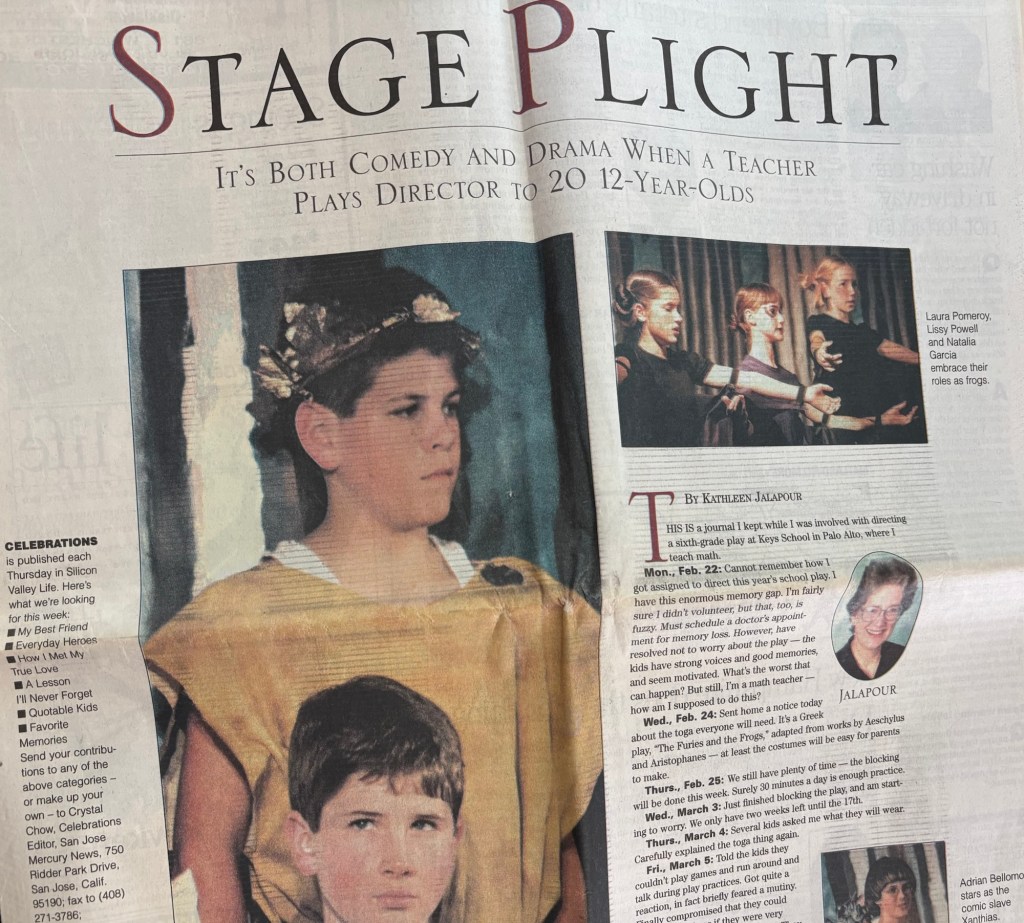
The Directing of a 6th Grade Play – A Journal

                                                           Published in the San Jose Mercury News, May 3, 1999

Mon., Feb. 22:      Cannot remember how I got assigned to direct this year’s  6th grade school play. I have this enormous memory gap. I’m fairly sure I didn’t volunteer, but that too is fuzzy. Must schedule a doctor’s appointment for memory loss. However, have resolved not to worry about the play – the kids have strong voices and good memories, and seem motivated. What’s the worst that can happen?  But still, I’m a math teacher – how am I supposed to do this?

img_3607

Wed., Feb. 24:  Sent home a notice today about the toga everyone will need. It’s  a Greek play – at least the costumes will be easy for parents to make.

Thur., Feb.  25: We still have plenty of time – the blocking will be done this week. Surely 30 min. a day is enough practice.

Wed., Mar. 3:   Just finished blocking the plays, and am starting to worry.  We only have two weeks left until the 17th.

Thur., Mar. 4:   Several kids asked me what they will wear.  Carefully explained the toga thing again.

Fri., Mar. 5: Told the kids they couldn’t play games and run around and talk during play practices. Got quite a reaction, in fact  briefly feared a mutiny.  Finally compromised that they could play Clue or chess if they were very quiet and listened for  their entries. They went into the kitchen to “play quietly”. Somehow a drawer handle got broken and the dishwasher turned on. The whole enterprise seems doomed. I took them back to the classroom. The music teacher came and talked to them, which didn’t seem to help. I am in despair.

Mon., Mar. 8:  The art teacher had the kids start painting columns today. I was surprised she’d planned a double period for it. Surely twenty kids don’t need 90 minutes to paint four cardboard columns.   Began cutting wings for the Furies after school. Went to look at the columns. Somehow they didn’t get finished.   I have a bad feeling about this.

Tues., Mar. 9:  Got the kids out of class today to practice, only to find another grade practicing Pirates of Penzance on stage with the music teacher, so we had to turn around.  Have decided next year’s 6th grade play will be a musical. Talked to kids about  play related things – how to learn lines best, who might have props we need, and what they would wear. Several wanted to know what a toga is.

Wed., Mar. 10:     Practiced an hour  and a half today. The play will never be ready by next week. It is a thing of impossibility.  The kids don’t know their lines, they miss entrances, they get noisy while waiting  and start running around and playing with the props – especially the whip. And the columns aren’t done. Have decided  that trying to  keep seventeen  12-year-olds quiet while three of them do the same scene over and over with me on the stage is not for the faint-hearted.    I think I need a vacation.   I think Kyrgyzstan  sounds good.

Fri., Mar. 12:  Practiced 3 hours today, plus somehow the columns got finished, although they look rather surrealistic. Have decided not to worry about the play for three days now, during the long weekend.

Sat., Mar. 13: Woke up worried.  Began to type up the list of scenery changes and props when I realized there are 4 scenery changes in Scene 2 . Have a bad feeling about this.


Sun., Mar. 14:  Woke up worried. Retyped list of scenery instructions, but cannot visualize it working yet.

Mon., Mar. 15,  5 p.m.:   Had to lead a workshop at a teacher’s conference today, so I spent most of the weekend preparing for it. The teachers in my session  were very quiet, and although they thanked me afterwards, they  were so passive during the presentation, I’ve decided I prefer kids. At least you get some feedback.  I wonder what kids are like in Kyrgyzstan.

Mon., Mar. 15,  8 p.m.   Had several calls this evening asking what the kids are supposed to wear. Told them to send a sheet and some safety pins. 

Tues., Mar. 16:  Dress rehearsal – practiced four hours today. The  kids still forget entrances, lines and  props. Some still don’t have togas. Plus it took them 30 minutes to get into costume, without make-up. Have added another  rehearsal tomorrow, although it’s supposed to be bad luck on the same day as your opening.  Definitely have a bad feeling about this.

Wed., Mar. 17,    7 a.m. :  Woke up worried, and with a sore jaw from grinding my teeth. Checked flights to Kyrgyzstan on the internet before eating breakfast. None scheduled for today, which gives me a bad feeling.

Thurs., Mar. 17,   noon:   Practice went better this morning, except for the 4 scenery changes in Scene 2.

Fri., Mar. 17,  3 p.m.:   Hallelujah!!  The performance for the school went well! I am stunned! Kyrgyzstan fades into memory. I cannot believe how well things went. No missed entrances or lost props, and even the scenery changes worked.  Got to sit back and enjoy the show. Hope tomorrow night’s presentation for the parents goes as well!

Thurs., Mar. 18,  5 p.m.  Got other teachers to help me set up chairs in the auditorium now, since it couldn’t be done during the day. Today was the school’s Rancho Day – the auditorium is now decorated in a Wild West motif.  Have decided that timing is important for this kind of production.  Will remind the music teacher of this next year when she directs the 6th grade musical. 

March 18,   10 p.m.:   Play went well tonight, too, except for the moment when  Joey almost fell off stage.   Got to sit back and enjoy the rest of the play, which was really very good.  The kids were great! Where  did these angelic children get their wonderful acting ability, poise, timing and beauty?  Was everyone else not as charmed as I?  How could I have been angry at them last week?  Surely it is a trick of memory. Hugged them all tonight (as many as I could catch, anyway), and will praise them extensively tomorrow.  What a wonderful thing the theater is.

A Place I Hardly Knew

Winner, South Bay Writing Contest, 2007

My first delivery was longish and hard. By the 16th hour, I no longer had any sense of time, or of myself as a person, other than in pain.

The nurse pulled me back, her hand on my forehead, pushing my hair back, forcing my eyes open. “You can do this.”

I look up in resignation, too weak to feel anger, and suddenly it is Mrs. Goodwin who is looking down at me. Gritty, middle-aged Mrs. Goodwin, my high school swim coach, her dust-colored hair cut in an unattractive bob, her strong chin jutting at me.  I wonder briefly at her presence, but of course it makes sense. She’s come to mock my pain, as she always did.  

“I can’t go on,” I mumble to her from the poolside, where I’ve attached myself, barnacle-like—coughing and exhausted.

She crosses her arms and glares at me over her glasses. “You say the same thing every September. You come in here out of shape, I give you a normal forty laps, and you’re in tears by the twentieth.”

I loathe everything about her—plain face, gravely voice, steel-grey eyes. Maybe I deserve a break in September, did she ever think of that? I’m not one of the rich country club kids who swim all summer, the amazons who pass me by the second lap in our first week of practice back at school. I’ve spent my summer reading in my bedroom.

My breath is still ragged, but I find the strength to feel anger. “I can’t! I’ll drown if I swim another lap.” I look down, kicking weakly at the wall in frustration, hiding the tears that do, in fact, sting my eyes.

Mrs. Goodwin kneels beside me, the hem of her shapeless gym shorts just touching the puddle on the wall beside me. She grabs my forehead, pushes back, and puts her face an inch or two from mine.

“Two things, girl, if you learn nothing else from me. First, remember last March, the swim meet down south?”

“But I didn’t place.” I try to pull away from her, but her grip is strong and cold as ice.

“No, but you broke your own record for the 100-meter back. You told me afterwards that you couldn’t remember the race. Like your body had become part of the water.”

Something inside me gives in, knowing she is right. I remember. I remember breaking through the pain, the tears, the doubt—my body just swimming, as if it were never meant to do anything else.

She sees my face change, lets go of my forehead.

“And the second thing?” I ask, sighing, trying to gain a few more seconds before she sends me back down the fifty-meter tunnel of water.

She snorts, stands up. “Well, it’s what I always say. You know my rule about swim practice.”

“I know,” I break in, coughing. “When you think you can’t go on, it means you’re about half done.” I turn reluctantly, push off the side and begin the torturous trek down the lane, ignoring the rubbery pain in my muscles, the burning in my lungs. The voice in my head gradually turns off, and my arms and legs take over on their own, their rhythm coming from deep inside me—a place I hardly know.

The nurse takes my hand, massages my shoulder. “You can do this,” she says quietly, peering at me. “You have to.”

“Yes,” I answer. “Yes, I know. We’re only half done here.” And with the next contraction, and the next, and the next, my body takes over, taking directions from a place deep inside me — a place only one other person ever knew existed.

Flight from Egypt

Winner of the Palo Alto Short Story Contest for 2005

“Banu,” he whispered, kneeling on the fringed cushion by his daughter’s bedside. The lids flickered, opened. For a moment, the dark eyes flashed pain and anger, then recognition. The lips moved, managing a weak smile and a single word.

“Abu.”

Father.

Amal’s stomach clenched, and he felt an angry poison spread outward through his body. He closed his eyes, inhaled slowly, trying to regain his self-control, unclench his fists.   It had been three days now since they had brought Banu home. One eye was still black and swollen, her right arm lay in a splint, and the bruises on her arms and back were fading to sickening shades of purple and yellow.

“Her body will heal, but her soul is dead,” Amal’s wife, Farida, had hissed at him that first day. “This is your fault. You wanted her to marry Kamal. I was against it from the beginning. This is on your head, Amal Taher.”

Farida had not spoken to him since then.  Padding through the rooms of their apartment as she nursed her daughter, Farida seemed half-dead herself.  She appeared and disappeared like an apparition. Amal would sense her presence in a room, turn to look, and find the room empty.  He missed their evening talks, the closeness they’d had through their years together, especially raising Banu.

            Amal opened his eyes, leaned forward and kissed Banu on the forehead, touching her black hair gently. He heard the phone ring in another room, and rose to answer it, knowing Farida would not.

“Masa’a al-khair, Dr. Taher.” came a voice as he picked it up. “I hope you are well, Allah protect you, sir. I hope you are not too tired this evening, sir…it is only…we have a foreign guest here at the hotel, doctor. She is very sick – Allah forbid she should die in my hotel. I know it is late, Dr. Taher, but for a good doctor, dedicated and generous as you are, sir, I thought I can phone and beg this favor.”

It was Samir Laakhair from the Hotel Luxor. Amal hated making calls at the Luxor. It was one of the cheaper hotels in Cairo, catering to young Europeans in dirty jeans and unwashed hair. Had they no honor, these parents? How could they let their sons – and especially their daughters – run around in shorts and dirty t-shirts in another man’s country, laughing and kissing each other in public, doing God knows what in private, disgracing not only themselves but the minds of his young countrymen as well?

            He sighed, told Samir that he was on his way. Perhaps it was preferable to an evening at home with Farida, he mused, and immediately felt a stab of remorse at the thought. She was right – it had been his idea to marry their daughter to Kamal Bakhshi. The Bakhshis had made a fortune in land speculation, it is true, but they were newly rich, with none of the breeding and character that he should have looked for in a son-in-law. Farida had accused him of being blinded by their money, but he had insisted that he was doing what was best for Banu. She deserved a good life – he had always thought her beauty and gentleness would destine her to a life of comfort. Amal sighed again as he got in his car. Who could understand Allah’s will in this life?

            When he arrived at the hotel, it seemed even shabbier than usual. Peeling paint, dirty windows, spider webs in dark corners. Amal steeled himself to the squalidness. When he entered the patient’s small room, he immediately knew what was wrong with the young foreign woman. The smell of streptococcal pharyngitis filled the room –  a sore throat infection with swollen glands and high fever that was somewhat common among the young tourists, and always gave off the same fetid smell. Untreated, it could easily abscess and turn deadly, but with penicillin, it was completely curable. Approaching the bed, Amal wondered briefly at the patient’s looks – she was pretty, but not like most of the young tourists. She had thick black hair and dark lashes, with very pale skin which, flushed with fever, made her look like a Persian miniature painting. He looked in her mouth and felt the glands in her neck to confirm his initial diagnosis, and opened his bag to get out the penicillin.

            There were two other young hotel guests in the room – a short, chunky redheaded girl with bare feet, hanging on to a tall young man with blond hair that hung in ratty, rope-like coils. When she saw the hypodermic, the girl began waving her arms at Amal like a  windmill,  emitting a string of incomprehensible syllables. He stared at the girl, searching for meaning, and realizing finally that the torrent of words was English.     The girl was protesting the cleanliness of his hypodermic. What arrogance! Did they think he, an experienced doctor, graduate of the best university in Egypt and older than both of them put together, would use a dirty needle on a foreign tourist? If they had kept cleaner habits themselves, they wouldn’t be in this fix.

            Samir and the young man took the girl’s arms and talked to her as one talks to a child, and she finally sniffed and  turned her back on Amal in a last vain protest.  Amal administered the penicillin carefully, checking the patient for a reaction, but she seemed unconscious. Her breathing was shallow, and he felt for her pulse. It was light and fluttery, and her skin was hot to the touch.

             Amal stood up again, crossed his arms, and tried to look down his nose at the tall young man. “Why you not call doctor sooner?” he asked haltingly in English.

            “Umm.. money…?” mumbled the young man. “Sorry, old chap. Is she going to be all right?”

            “Inshallah, yes. But I come again. Tomorrow. More penicillin.”

            “Yes, well, that’ll be fine.” He made a flippant motion toward the bed.  “Rosanna’s parents wired money to us today, so we can pay whatever it costs now.”

            Amal gave the young man his most disapproving scowl, and turned to the patient again. “Rosanna,” he said softly. And then in Arabic, he repeated the prayer he always spoke over his patients. “Merciful Allah, there is no cure but from You, a cure which leaves no illness behind.”

            He got a call the following day at the clinic. It was Samir again, in a fluster. “They left, Doctor Taher, sir. They all left! What shall I do, in the name of Allah?”

            “Who left, Samir?”

            “The young people with her – with the sick girl – they just left. They left an envelope with money on her bed – how could they just leave her in my hotel? In the name of the prophet, what shall I do?”

            Later Amal would never be able to say why he did it. “Take her to my place, Samir. Tell Farida she is to care for her like a daughter.” He did not tell Samir that Farida already had a daughter to care for at home. He knew well that Farida would not tell him, either. The shame was too great. He also knew Farida would follow his directive. Whether she would do so willingly or not, however, he could not say. God willing, this too will pass, he said, and lowered his head to rest wearily on his folded hands.

            A week passed, ten days, and his home began to come to life again. Farida blossomed in her role as caretaker, and began speaking to Amal again. The young women recovered, and a quiet friendship began to develop.  Rosanna was soon able to tell them about herself – she was American, but had Lebanese grandparents on her father’s side, and spoke some Arabic. Her grandmother, a portly widow who had taken such joy in Banu’s birth and early years, died when Rosanna was four, and Rosanna had quickly forgotten her Arabic, as children do. But the language was still there, in the recesses of her mind, and came out in bits and pieces – new phrases every day.  It made everyone laugh when Rosanna spoke, for she spoke like the  child she had been when she briefly learned Arabic. “Me can do it!” was the first thing she said to Farida, who was trying to feed her some soup with a big spoon on Rosanna’s second day in the house. Farida dropped the spoon in surprise, and then broke out into a big smile – her first in days – and a flood of fluent Arabic: “God bles

 She learned quickly, though, and soon spoke in short sentences. She began giving Banu English lessons every afternoon, and Banu proved an equally good student.

            They were soon well enough to help Farida with the household chores, and to care for the doves the family had always kept on the roof. They took each bird out of the large coop, cupping their hands around its wings and speaking softly to it. It touched Amal to see the two dark heads bent together, giggling like sisters while they whispered to the doves.

            One evening Farida was waiting  for  him at the door when he came home from work. “I must speak with you, Amal Taher,” she said, pulling him into the kitchen. “Rosanna has invited Banu to come with her to America. Banu must accept, Amal.”

            “What? America? No!” Amal’s mind reeled at the thought of his only child so far away.

            “Don’t fight me again, Amal, I know I am right. Banu has no future here. She can divorce Kamal, but no one else will marry her now – you know that a divorced woman has poor prospects. What are we supposed to do, Amal Taher?  The police will do nothing to help us punish Kamal.  His family is too powerful, and we can’t find him by ourselves – they have hidden him somewhere. It would be too hard for her to get into university here, she has not even taken the entrance exam. In America, she can study, make a new future for herself. It is what she must do, Amal. It is the only way she can forget.”

            “You don’t know what you’re saying, Farida,” pleaded Amal. “It’s not as easy as you think. She doesn’t speak much English, we don’t have relatives there. It’s expensive. And she’d be alone,  Farida. It’s not like here. She would be completely alone, for God’s sake.”

            “No, Rosanna has said she can live with her. Banu can be her … what did she call it…. ‘roommate’. It is not so expensive. We can send money, and Rosanna says Banu can find work while she learns English.”

            “Work?” sputtered Amal. “Work? Like a brat from some hamal family with no education, no class? Young girls do not work! It is not the way, Farida.”

            But it was the only way. Banu wanted desparately to go. Amal was convinced that she would suffer all the trials of the immigrant – the homesickness, the horror at cultural habits strange and illogical, the weariness of always having to adapt, change and accept. Worst of all, in the end she would assimilate.  She would lose her identity, and he would lose his daughter. But Banu was full of hope, and in truth, happier than he had seen her in all the months since her wedding. Finally he gave her his blessing, holding her close, his rusty tears falling into her hair.

            The day before they were to leave, Banu went up to the roof, opened the coop and freed all the doves. The white birds circled upwards, disappearing into the great expanse of Egyptian sky. “I needed them to be free, Abu,” she confessed. “Like me.”

            Amal and Farida returned from the airport in silence, nursing but not sharing their emptiness, resentment, pain. Amal wondered if their marriage would ever be the same. How do you give up a child? What else will be sacrificed? What demanded?

            He was parking the car in the street when he saw it. He turned off the motor and ran. Kneeling on the pavement, he picked it up.  It was one of the doves Banu had freed. It was dead. Killed. Apparently by a hawk. Amal curved his body around it in pain, and wept.

My Legacy

Written 2023

Life is a slow river whose ripples push against one another, intersecting watery paths of love, pain, joy and growth.  The river’s progress – though slow – is dogged, and on its banks it leaves behind tiny, fragmented bits of memory. The detritus of a long life.

I spent my childhood learning my mother’s patience, adopting the self-sacrificing ethic that she embraced so generously that she did not even know its truth. If I have watched my own children struggle successfully to free themselves from this recursive pattern, that is a legacy.

I spent my youth catching a flame of passion for human justice and equality. I joined anti-war groups, embraced feminism, and married a dedicated activist from the Third World. If our raised voices of protest ever influenced policy, or added sense to someone else’s world view, then that is a legacy.

I spent my work years learning how to teach. It is an impossible assignment; you can never perfect this craft. It is an undertaking of love, of dedication, insight and recovery from unavoidable, infinite failures. If I have lead dozens of young humans to stop hating math, and to gain back the self-esteem that subject should never have stolen from them, then that is perhaps my favorite legacy.

I spent my parenting years struggling to juggle a job, a household and two school-aged children. My own needs disappeared; I rarely remember getting enough sleep. Perhaps this was the core purpose of my life; I haven’t made that call yet. But if my soul was a jug of water, I poured all of it into raising them.  They are good people – strong, thoughtful, and playful, with a love of nature, travel and adventure. This may become their legacy.

I spent my late 50’s recovering from a brutal brawl with cancer. My Keys School community, my husband’s friends and my own family – everyone was there for me. My son drove up every month from Santa Barbara. I received hundreds of letters, dinners, gifts and encouragements. I got a requiem without even dying. If my survival has given other sufferers hope, this is a legacy I do not deserve, but will accept.

I spent my mid-60’s in a depression around a three-year estrangement from my daughter, who walks on water. Who, together with her brother, hangs the moon. I waited, I sent occasional kind words, I learned to reflect on my life’s mistakes and acknowledge them, and I survived, and still adore her. If I have shown my adult children an openness to vulnerability  and introspection that they can respect, then that is a legacy. Perhaps a painful one for me, but valuable. As the Persian poet Rumi said, “The wound is the place where the light enters you.”  

In my early 70’s, two sacred events occurred. My mother died and my first grandchild was born. Only a few months apart. My mother was a gentle soul, and it was easy to care for her in her last 3 years. My grandson, now almost one year old, is a ray of sunshine. He is forever smiling, he loves to make eye contact with strangers from his perch in his stroller, and if they look back, he smiles broadly and bats his eyes at them. There was never such a child in our family. If this is God’s gift to me for a life well struggled through, I am blessed. If this child is a mosaic of every person in two extended families, including a few molecules of Kathleen, then that is a sacred legacy.

The Evolution of a Math Teacher Part I – California to Berlin

Spring 2023

Childhood can be a stressful time, in any society. I have 65-year-old memory that is as vivid as yesterday’s dentist appointment, and twice as painful.

It was fourth grade. Timed tests in math –  100 problems in 3 minutes. I remember forlornly clenching my pencil, defeated once more by the times tables as the numbers grew fuzzy in my head. When the teacher gathered our papers at the end of 3 minutes, mine had more teardrops than answers on it, and a boulder of shame pushed down on my shoulders, sat in my stomach. “Why am I the stupid one?”  

That teacher wanted me to repeat fourth grade, but my mother protested, all the way up to the principal. “Kathy is strong in every other subject – holding her back would set back her education and her confidence.” (A battle already lost, Mother) She got her way, but math woes followed me doggedly for years. I finally dropped math after 10th grade, and good riddance. My counselor assured me that was fine – “Most girls don’t do well in the higher math classes anyway, dear.” The year was 1965. This time, my  parents didn’t protest either. Did they buy into the “Girls vs Math” creed too? Or had they accepted my shortcomings?

My brothers would never have been permitted the same path, but I was allowed to drop math and take Music, Typing and French; for none of which I had any special talent. I still called myself ‘The Slow One’, particularly because my three brothers were so infuriatingly gifted in math and science.

I graduated high school with pretty good grades (all it took in the 60s was being quiet and doing the homework) , and went off to Humboldt State College, 20 miles from our home. As a music major, out of a lack of confidence and passion for any more academic subject.

In my sophomore year, I signed up for California’s “Junior Year Abroad” program, and – hallelujah – my parents agreed to pay for it. By April it was all set – I was going to Berlin, Germany for a year. In the spring quarter of that final year at Humboldt, I took the last General Ed class I knew I’d need to graduate after I came back.  Introduction to Economics.

You know those moments in your life that no one could ever have predicted? Moments when a door creaks open and you just walk through, a pilgrim on the road to an unfamiliar Damascus? I loved that class.

It spoke to something inside me. Human nature can be quantified. Every choice we make is based on invisible calculations. Social ills like poverty, monopoly, racism and misogyny are results of economic structures that can be changed. Most enticing of all, economics teaches us to think at a societal level, not an individual level, and is therefore more logical and mutually beneficial than some inward-facing field like psychology. My imagination opened up; I could see demand curves shifting, feel the decline of marginal utility, intuit the efficiency of a more equitable tax system. Economics works the same way my brain works – creating a big-picture tapestry that is both emotional and logical. I could see history painting huge, dynamic murals of social movements.

Who knew I would show a talent at something? I ate it up, did more than the assigned work, and saw my confidence germinate. I went to my advisor, and wanted to know if I could change my major. Would I be able to finish an Econ degree when I came back from Germany? How many classes would there be?

He looked at my transcript and frowned. “You know Econ has a calculus requirement, right?”

Calculus. Isn’t  that something the dentist takes off your teeth? No, I knew what it was. I’d seen my brothers fill pages with it. Damn. Would I never escape?

But still, I was thrilled to be going abroad. I would finally be truly on my own. I would figure out my future later. In August I boarded the airplane – my first ever – full of a sense of grand adventure and escape. Eager for adulthood.

I ended up spending fifteen years in Berlin. I paid my own way, working on weekends as a dishwasher, phone operator, factory worker, warehouse packer, hotel maid, nurse’s aide, envelope stuffer and English tutor. I even had one job packing – and occasionally modeling – mink coats for a fur wholesaler.

I struggled to learn German well enough to pass college classes in Business Law or Finance Theory. But I persevered, and I finally passed. As the semesters passed, my confidence began to grow. I finally signed up for my required Calculus class.

“If I can learn German grammar, I can do this,” I told myself. But no, I failed. It was too late to turn back; my whole definition of self depended on graduating with this degree. So I spent the whole summer studying math. Algebra 2, Trigonometry, Pre-calculus. I was 23 by now, maybe finally adult. Maybe finally better at abstract thinking. Maybe simply appreciative of the similarities between German grammar and math. Whatever it was, I began to understand math. And in December, I passed Calculus.

And I got to live all those years in Berlin, the walled city, the most exciting, creative city in Germany. My living costs were low – the student housing, student cafeterias, and public transit were all highly subsidized. My health care was free, and  so was the university. I began teaching English to adults at night school, and easily supported myself.

I graduated in 1977, and married Amir soon after. Our daughter was born in 1978 and our son in 1980.

We were lucky enough to get a 2-bedroom apartment in the dormitory complex we already lived in. I remember feeling satisfied with my life. I think the word is ‘happy’. My confidence was healthier, I had dozens of friends, my marriage was loving, and I even got a job teaching at a college on the American military base. I only taught a few times a week; I was a young mother and wife, and Amir was earning enough to support us.

I taught Economics and Math.

Math?

Really?  How did that happen? Was I converted? A new math devotee? Hardly, but competent enough, and proud of it.

So there I was, teaching Algebra to enlisted men at the American base on Clay Allee in the south of the city. There were thousands of US troops stationed in Berlin at that time, deep in the Cold War. I was pregnant, it was the depth of winter, and snowing. I had a morning class 3 days a week, and the young GIs signed up because, heck – it beat washing tanks outside at -5 degrees. The one officer in the class – a lieutenant – sat in the front, but turned sideways to watch and make sure that no one nodded off. If any of the men failed even one of my tests, they were back out in the snow. The Army understands from motivation. I had enormous sympathy for the ones failing. But I’d made it through that maze; maybe others could, too. Look, I told them, it’s pretty straightforward. First, outside, inside, last.

Wait, no – you multiply  the firsts and middles and lasts, and then you add them, not the other way around.

Practice. Just practice.

No, one page is probably not enough.

Believing in Stardust

In the beginning, there was nothing.

Well, almost nothing. There was one very small something, but it was so small it hardly counted – it was maybe the size of a basketball.

Such a tiny ball – infinitely dense, scientifically speaking – and chock full of energy, heat and intelligence.

This being a creation story, I assume the being was feminine, and that she was curious about the rest of the universe. Of which, of course, there was none.
Not even blackness or emptiness, just Nothing. (I am sure I cannot even imagine this, given the poverty of my normal human brain.)

The being – I will call her Cosma – found this nothingness confusing. Her energy, intelligence and gender made her grow more and more curious about her origins.  “Why do I exist, if not to serve some purpose?”

“And what purpose can I possibly serve when everything around me is simply not there?”

There was no one to talk to about this philosophical dilemma, so Cosma spent eons in lonely, soul-searching contemplation. And it came to her that there was only one solution. Only one colossal act of self-sacrifice would solve both her solitude and her lack of purpose.

Her decision made; the enterprise launched. Cosma began to pulse – contracting, expanding, vibrating with incalculable intensity.  Finally, in a daring, heroic act of cosmic genesis…Cosma exploded.  

It was a cataclysmic release of matter, a never-ending cascade of life. Sound, light, color, time, space, solar systems, galaxies and universes erupted. The magnitude and beauty of the event were staggering.  

But Cosma herself no longer existed.  

Or did she? She had planned for this moment. “I die creating order,” was her last thought. “Magnificent, sacred, unimaginably beautiful order.” So her fledgling universe expanded along her own divine laws of gravity, thermodynamics, isotropy, evolution and – yes, death.

But Cosma did not exactly die. Although no longer sentient, molecules of her are everywhere with us – every atom, every cell, every force of nature. Her devotion vibrates through every corner of her masterpiece.

Of all the undeserved glories! We humans, such an insignificant speck in her vast universe, are part of her stardust.

But we forget this too often – we lose need for harmony with others, we lose gratitude for the inexplicable gift of life. We forget that the existence of death should mean that pettiness is useless, and avarice completely nonsensical.

It turns out that we humans are at our best when hardship forces us to recognize our unity with others. And we do have our grand moments! Heroism, motherhood, generosity, altruism… over the millennia, we’ve thrived by learning to be good at cooperation. We can be penguins, we humans, gathering in circles of mutual protection.

We can channel Cosma’s miracle. We can show compassion. We can, at peek moments, feel the unity with everything everywhere.

That is our greatest strength.

We call it love.

Two B­­­irthdays and the Meaning of Life

2024, in response to the prompt “Describe a memorable birthday”

My two most memorable birthdays – one dismal and one joyful – lie only 12 months apart. My 60th and my 61st birthdays.

In the spring of  2010, a few months before I would turn 60, I went to the doctor because of a lump I could feel in my breast. The doctor felt it and said, “You’re going over to radiology today.”

 “I can’t,” I offered, “I’m busy this afternoon.”

“You are now,” she answered.

There followed 30 days of scans, biopsies, consultations, and cascading bad news.

My breast cancer got sequentially renamed –  “malignant”, then “triple negative”,  and “aggressive” and finally, “metastatic”.

But I had a fearless oncologist. She tried to get me into a new clinical trial that I ended up not qualifying for.  One morning she called me at 6:30 am to say she’d been thinking about me all night and decided to change my chemo plan. I was bleary-eyed and could only stutter “Yes, ma’am.” And she was honest with me, from the beginning.

When she first told me my diagnosis, I was overwhelmed with contradictory emotions. Yes, there was fear, but there was also, surprisingly, an underlying feeling of relief. For the first time in my life, I would get taken care of.  I would be the receiver, not the giver.  

I’ve always worked – I got my first job at 16; I worked my way through college. I’d been a working mother throughout my 30s, 40s and 50s – an exhausting life on any planet. I was a teacher —  a middle school teacher – another compassionate but stressful load to carry.

I don’t really remember feeling sorry for myself through all those middle decades, but maybe I should have. Maybe I should have complained. What is it called today? Self-advocacy, yes, and “setting boundaries.” But for better or worse, women of my generation and background were raised to be strong and selfless.  

So, for the first time, I did get taken care of. My friends and colleagues signed up to bring dinners. My kids visited from Berkeley and San Diego. And my husband became a pillar of positive energy and support. He camped out in medial offices to get appointments; he insisted on juicing beets (yuck) for me every morning because he’d heard it built immunity. He refused to read my medical diagnoses and assured me daily that I would be “fine”.  This was new and out of character.  I had always been the strong one. I remember wondering “Who IS this man?”, and I began to believe him. Maybe I would make it. And, to be completely honest, as much as I hated the chemo, I enjoyed the attention and the nurturing.

Until I didn’t. After spending the whole summer struggling with the poison that is chemo, my upbringing reasserted itself. I called work and arranged to teach half-time starting in September. No one understood why, least of all me. I could have stayed home for months on disability.  I could have played the grateful invalid for God knows how long. But I went to work. And then in mid-October, I ended up in the emergency room. High fever, flu symptoms, chest pain. They let me go home again the next day, but on quarantine, at least until my surgery on Oct 28th. No visitors, no activities, no working. I cried for hours. “What’s the matter?” an old friend asked on the phone. “I just want to work.” I sobbed, surprising myself. 

“Watch a documentary on sled dogs,” she said.

So I watched a couple. Turns out sled dogs LOVE to pull. They LIVE to pull. When the musher sets up the sled, the dogs go into a frenzy, clamoring over each other in the kennel. “ME, pick ME!” Once the chosen dogs are in the traces, the musher occasionally has to force them to stop and rest, or they’d pull until they collapse.

Hmmm. 

I had sufficient time to think about this, in quarantine, sitting at home, trying to get healthy enough for a double mastectomy on Oct 28th.

My generation suffers from contradictions unique to our era. We were raised by women whose role in life was giving and supporting, feeding and nurturing, and always putting themselves last.

But me – I came of age in a time when women were beginning to rail against the shackles of that role. Feminism, environmentalism, social change – my head believed fervently in these causes, but once I was married and a mother, my heart didn’t. I followed my mother’s example too often. Children, husband, money, work – all those things came first. I found myself constantly compromising, reshaping myself, trying to make everyone happy.  And now, at 60,  forced into a corner where I had to think about death, I did not slip into regret about lost opportunities. I fell back on that which I knew. Work.

My 60th birthday came and went,  just another day in bed. I did recover from the surgery, I tolerated the 6 weeks of radiation well, and finally got my first good news. It seemed there was only one metastasis, and it had shrunk slightly. If it stabilized, if there was no change for five years, I could consider myself healed. And by some miracle, deserved or not, I am still alive, 14 years later.

So I celebrated my 61st birthday the following October. My hair was growing back, my energy was returning, I was back at work, I was grateful. Dozens of friends and family members came. We cooked food together, sang karaoke, drank a little too much and laughed at fate. My best birthday ever.

I worked another 10 years – until I was over 70. And I still don’t know why. In fact, I still do some tutoring and teacher training. Officially, I say I like the extra money, but I suspect that’s not all of it.

I hope it’s more than just female respect-seeking.

I hope that as I approach old age, and sit judge on my life, I rule in favor of having lived a life with meaning. I hope that I become able to forgive myself for ignoring my own needs and  for not setting a better example for my own daughter.

I hope I come to peace with an understanding that sled dogs are not martyrs. If they keep running when they should quit, it is out of courage and devotion.

When they beg to be put in the traces, it is because they long for the success of the team.

When they show self-sacrificing dedication to work, they rise above individuality and find a higher social consciousness. A oneness with the universe.  

And I hope that the universe … I hope the universe is grateful.